How to visit Plaszow Concentration Camp
Plaszow (Płaszów) Concentration Camp is a former Nazi camp in Krakow, best known for its role in the liquidation of the Krakow Ghetto and its connection to Schindler’s List. Today, the site stands primarily as a vast memorial landscape rather than a preserved camp complex, meaning that the visit depends on carefully reading the site itself rather than simply moving through museum rooms. What often distinguishes a more meaningful visit is arriving with a considered route in mind. This guide covers timing, access, memorials, and how to approach the site with the respect and reflection it deserves.
Quick overview: Plaszow Concentration Camp at a glance
This is a free, open-air memorial, though it is best experienced with more planning than many visitors might anticipate.
- When to visit: Monday–Sunday: Best visited during daylight hours. Weekday mornings before 10am are usually quieter than summer weekend afternoons. The site is fully open and largely unshaded, with limited signage from surrounding streets, and guided groups typically arrive later in the day.
- Getting in: From $0 for standard entry. Guided tours usually start from about $30. You can show up freely, but guided tours are worth booking a few days ahead in summer or if you want a non-English guide.
- How long to allow: 1–2 hours for most visitors. It stretches toward the longer end if you read the outdoor panels properly, walk to Hujowa Górka, and detour to Amon Göth’s villa.
- What most people miss: The gravel outline of the former Appellplatz and the archaeological display cases are easy to walk past, even though they make the empty landscape easier to understand.
- Is a guide worth it? Yes, if you want the site to make sense quickly; without context, much of Plaszow can feel like open ground, while a strong self-guided visit works if you’re willing to read slowly and follow the memorial route.
Jump to what you need
🕒 Where and when to go
🎟️ Which ticket is right for you?
🗺️ Getting around
🕯️ Memorials to prioritize
♿ Facilities and accessibility
Where and when to go
How do you get to Plaszow Concentration Camp?
Plaszow sits in Podgórze, about 5km south of Krakow’s Old Town, with Kraków Płaszów station and the Podgórze tram network as the nearest useful access points.
ul. Jerozolimska 3, 30-547 Krakow, Poland
- Tram: Dworcowa/Podgórze area stops → 10–15 min walk → follow local signs toward KL Plaszow through the residential streets.
- Train: Kraków Płaszów station → 15 min walk → easiest if you want to start at the Grey House entrance.
- Taxi/rideshare: Drop-off at Jerozolimska Street → 2–3 min walk → the simplest first-time arrival point for the main memorial route.
Which entrance should you use?
Plaszow does not have one formal gate, and that is what confuses most first-time visitors. The clearest choice is to start where the site gives you the most context straight away.
- Jerozolimska Street entrance: Located by the Grey House. Best for first-time visitors and self-guided walks. Expect no entry wait.
- Swoszowicka Street entrance: Located closer to the hill and main monument. Best for visitors short on time who want to reach the memorial core first. Expect no entry wait.
- Residential trailheads: Located around the site perimeter. Best for locals or returning visitors who already know the layout. Expect no entry wait.
When is Plaszow Concentration Camp open?
- Monday–Sunday: Open-access memorial grounds; best visited in daylight hours.
- After dark: Grounds remain physically open, but there is no lighting and the site is not recommended at night.
- Last entry: There is no ticketed cutoff, but you should plan to finish before dusk.
When is it busiest? Weekend afternoons from May to August draw the most visitors, and the exposed paths feel hotter, busier, and less reflective once walking groups arrive.
When should you actually go? Weekday mornings or late afternoon give you cooler temperatures, quieter paths, and more space to read the boards without feeling rushed.
Which Plaszow Concentration Camp ticket is best for you
| Ticket type | What's included | Best for | Price range |
|---|---|---|---|
Self-guided memorial visit | Outdoor memorial access + marked paths + information panels | A short, independent visit where you want quiet reflection and do not need a fixed schedule | From $0 |
Self-guided audio guide | Outdoor memorial access + app-based narration + route support | A solo visit where you want more context without joining a group | From $8 |
Guided walking tour | Outdoor memorial access + licensed guide + historical commentary | A first visit where you want the empty landscape explained clearly rather than piecing it together from panels alone | From $30 |
Schindler’s List combo tour | Plaszow visit + former ghetto sites + Schindler’s Factory Museum entry + guide | A half-day WWII itinerary where you want one connected story instead of separate visits | From $50 |
Private memorial tour | Private guide + tailored pacing + transport add-ons on some tours | A more personal visit where you want time for questions, reflection, or a specific historical focus | From $100 |
How do you get around Plaszow Concentration Camp?
Best explored on foot, Plaszow is manageable in 1–2 hours, though the full memorial route takes longer if you stop at every board and detour to outlying points.
The site’s main focal point is spread across open ground rather than gathered around one building, so orientation improves once you begin at the Grey House and move uphill toward the main monument.
Key areas and suggested route
- Grey House → one of the few original camp buildings still standing → 10 min
- Appellplatz area → former roll-call square, now marked in gravel → 10–15 min
- Hujowa Górka → execution site marked by a wooden cross → 15–20 min
- Torn-Out Hearts monument → principal memorial and strongest visual landmark → 15–20 min
- Amon Göth’s villa → outside the memorial boundary, but relevant for Schindler’s List context → 10 min
Suggested route: Start at Jerozolimska Street, use the Grey House board to orient yourself, then walk through the Appellplatz area toward Hujowa Górka before finishing at the Torn-Out Hearts monument; most visitors do the monument first and miss how the site’s story builds across the ground.
Maps and navigation tools
- Map: Downloadable site map + on-site boards → covers entrances, memorial points, and route logic → get it before arrival from the memorial website or at the Grey House board.
- Signage: Wayfinding is much better than it used to be, but a downloaded map still helps because several paths enter from ordinary residential streets.
- Audio guide/app: App-based self-guided tours are available in several languages → useful if you want structure without a live guide → worthwhile here because the landscape is otherwise sparse.
- Large outdoor POI tools: Offline maps are useful in wet or low-light conditions → especially if you plan to include the Red House or Liban Quarry on the same walk.
💡 Pro tip: Download the map before you arrive. At Plaszow, the challenge is not distance, but understanding which open spaces carry historical significance.
What is Plaszow Concentration Camp worth visiting for?

Grey House
Type: Original camp structure
The Grey House is one of the few surviving buildings from the former camp, and it holds particular historical significance within the site. It served as an SS administrative building and prison. Its plain exterior stands in contrast to the weight of its history, which becomes clearer through the context provided on the nearby map board, helping visitors better understand the wider memorial landscape.
Where to find it: At the Jerozolimska Street entrance, right at the clearest starting point for a first visit.
Hujowa Górka
Type: Execution site
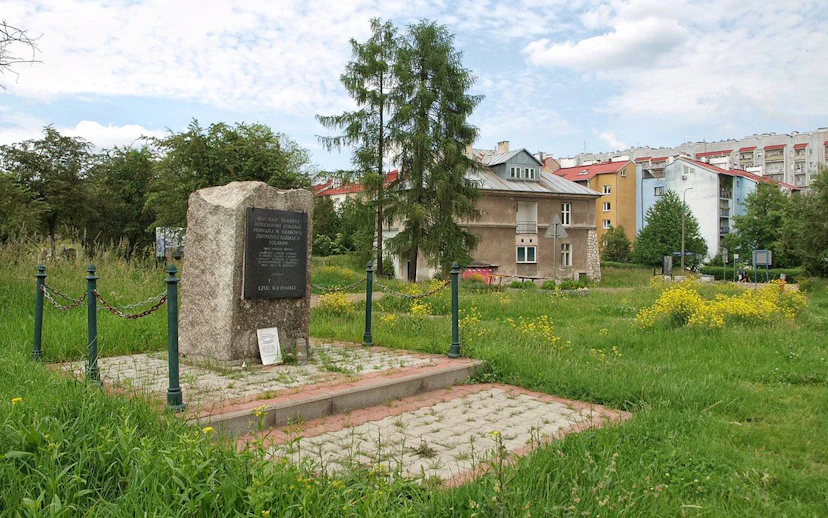
This is one of the most significant and solemn locations within the site, marked today by a wooden cross on a grassy rise. Thousands of victims were murdered here, and the Nazis later exhumed and burned bodies in an attempt to destroy evidence of these crimes. What often goes unnoticed is how understated the area appears today; without the nearby context, it can be difficult to recognize its full historical weight.
Where to find it: A short uphill walk from the central paths, beyond the main route between the Grey House area and the upper memorial zone.
Monument of the Torn-Out Hearts
Type: Main memorial monument
The Monument of the Torn-Out Hearts is the most visible memorial at Plaszow and serves as a key landmark within the site. Its scale is notable, as is its location within one of the former camp’s killing grounds. Many visitors capture its photograph from a distance before moving on, but walking to the base allows the inscriptions and smaller surrounding memorials to be read more closely.
Where to find it: On the higher part of the site, reached by the main uphill path or paved road from the camp’s center.
Appellplatz and archaeological windows
Type: Interpretive memorial zone
The former roll-call square is now mostly open ground, with its footprint marked out in gravel, so it only makes sense if you slow down. Nearby archaeological display cases show objects found during excavations, including small everyday remnants that bring the camp back into focus. Most visitors miss both because they are subtle and do not look like conventional landmarks.
Where to find it: Along the central walking route between the Grey House side of the memorial and the hill leading toward the main monument.
Amon Göth’s Red House
Type: Commandant’s villa
Although it sits outside the formal memorial area, this house matters because it connects the camp to one of its most notorious figures. For many visitors, it is also where the Schindler’s List connection becomes concrete rather than cinematic. What people often miss is that it stands in a normal residential street, which makes the contrast between everyday life and historical violence even sharper.
Where to find it: 22 Heltmana Street, a short detour beyond the camp perimeter in the surrounding neighborhood.
Facilities and accessibility
- 🗺️ Information boards: Bilingual memorial boards and route maps are the main on-site support, and they are essential for understanding what once stood here.
- 🪑 Seating/rest areas: A small number of benches are scattered along parts of the route, including near Hujowa Górka, but rest stops are limited.
- 🚻 Restrooms: There are no public restrooms on-site, so use facilities before you arrive.
- 🍽️ Food and drink: There is no café, kiosk, or snack stand inside the memorial grounds.
- 💧 Water: There are no refill points or fountains, so bring your own water in warm weather.
- 🅿️ Parking: There is no formal visitor lot, and street parking in the surrounding residential area is limited.
- 🚪 Entrances: Several open access points lead into the memorial, with Jerozolimska Street the easiest for first-time visitors.
- ♿ Mobility: The memorial is only partly accessible; some main paths are manageable, but grass, gravel, slopes, and execution-site approaches can be difficult for wheelchair users.
- 👁️ Visual impairments: The site relies heavily on outdoor text panels, and there are no confirmed tactile maps or dedicated audio-description tools on-site.
- 🧠 Cognitive and sensory needs: Weekday mornings are the calmest time to visit, but the emotional content is intense and the open landscape offers few structured breaks.
- 👨👩👧 Families and strollers: The route is not stroller-friendly end to end, and uneven terrain makes pushing a stroller tiring, especially after rain or in summer heat.
This memorial is best suited to older children who can handle Holocaust history and quiet, reflective spaces.
- 🕐 Time: 45–60 min is a more realistic visit with younger children, focusing on the Grey House exterior, one memorial stop, and the main monument.
- 🏠 Facilities: There are no family facilities, play areas, restrooms, or food stops on-site, so this is not a comfortable long visit with very young children.
- 💡 Engagement: Older children usually respond better if you frame the visit around one Krakow family or one survivor story rather than trying to cover the whole history at once.
- 🎒 Logistics: Bring water, sun protection, and shoes that can handle mud, and skip strollers if you can.
- 📍 After your visit: Schindler’s Factory Museum is the most meaningful next stop if your child is ready for more structured historical context.
Rules and restrictions
What you need to know before you go
- Entry requirement: The outdoor memorial is free to enter and does not require a timed ticket, but guided tours should be booked ahead if you want commentary.
- Bag policy: Small bags are fine, but there are no lockers or staffed storage points anywhere on-site.
- Re-entry policy: Re-entry is flexible because the memorial is open public space, though leaving mid-visit breaks the route and adds extra walking from surrounding streets.
Not allowed
- 🚫 Food and drink: Carrying water is sensible, but treating the memorial like a picnic spot is inappropriate.
- 🚬 Smoking/vaping: Smoking and vaping are best avoided across the memorial grounds out of respect for the site.
- 🐾 Pets: Dog-walking has happened here in the past, but it is discouraged because the area is a place of remembrance and mass burial.
- 🖐️ Behavior: Do not climb memorials, sit on commemorative markers, or use the grounds as casual recreation space.
Photography
Personal photography is generally possible across the outdoor memorial, including the main monument and the Grey House exterior, but this is a site of mourning rather than a photo attraction. Keep distance from plaques and memorial markers, avoid posed or celebratory shots, and leave tripods or selfie sticks behind if they disrupt the atmosphere or other visitors’ reflection.
Good to know
- Ground conditions: The grassy routes to Hujowa Górka and quieter memorial points get muddy quickly after rain, so waterproof shoes help more than most visitors expect.
- After-dark visits: The site has no lighting and very little foot traffic at night, so finish in daylight even though the grounds are not ticketed.
Practical tips
- Booking and arrival: You do not need to reserve entry for the memorial itself, but book guided tours 2–3 days ahead in summer if you want a specific language or a small-group slot.
- Pacing: Start at the Grey House even if the main monument feels more obvious, because the boards there make the rest of the open ground easier to understand.
- Crowd management: The best window is before 10am on weekdays, when the paths are quiet, the site feels more reflective, and summer heat has not yet drained the walk.
- What to bring or leave behind: Bring water, sun protection, and shoes that can handle gravel and wet grass; there are no restrooms, lockers, or shade-heavy rest stops once you begin.
- Food and drink: Eat before you arrive or wait until after you leave, because there is nowhere on-site to buy even a coffee, and the nearest easy meal stop is back toward Podgórze or the Schindler’s Factory area.
- Emotional pacing: Save time for Hujowa Górka and the Torn-Out Hearts monument, because those are the points visitors most often rush and later wish they had handled more slowly.
- Self-guided strategy: If you are not with a guide, follow the memorial sequence rather than wandering randomly, because Plaszow’s hardest truth is that the most important places can look deceptively empty.
What else is worth visiting nearby?
Commonly paired: Schindler’s Factory Museum
Distance: 4km — 10 min by taxi or about 20 min by tram
Why people combine them: This is the most logical pairing because the museum gives you the city and ghetto context that Plaszow itself does not spell out in full.
Commonly paired: Liban Quarry
Distance: 1km — about 15 min walk
Why people combine them: It sits right beside Plaszow, connects to wartime forced labor history, and adds another layer for visitors interested in Schindler’s List filming locations.
Also nearby
Ghetto Heroes Square
Distance: 3km — about 10 min by taxi or 15 min by tram
Worth knowing: The empty-chair memorial makes a strong next stop if you want to follow the story from ghetto liquidation to camp imprisonment.
Eagle Pharmacy
Distance: 3km — about 10 min by taxi or 15 min by tram
Worth knowing: This small museum gives a more human-scale view of life in the Krakow Ghetto and works well if Plaszow has left you wanting more context indoors.
Eat, shop and stay near Plaszow Concentration Camp
- On-site: There is no café, kiosk, or vending point at the memorial, so this works best as a before-or-after meal stop rather than a lunch stop.
- Ghetto Heroes Square area: About 10 min by taxi from the memorial, this is the easiest place to regroup for coffee or a light meal after a heavy visit.
- Schindler’s Factory area: About 10 min by taxi away, this is the most practical food stop if you are pairing both sites on the same day.
- Kazimierz: About 20 min by tram, this is the better choice if you want a proper sit-down meal and more restaurant variety after visiting Holocaust sites.
- 💡 Pro tip: Eat before you arrive or wait until after you leave — the combination of open ground, no shade, and no water points makes even a short visit feel longer in summer.
Staying right by Plaszow usually does not make sense for most travelers. The area is quiet and residential, which is useful for an early memorial visit, but it lacks the restaurant density, evening atmosphere, and hotel choice that make Krakow easy to enjoy. It works best if you are building a history-focused itinerary around Podgórze and Schindler’s Factory.
- Price point: The wider Podgórze and Kraków Płaszów area usually offers better mid-range value than the Old Town, with fewer premium options.
- Best for: Visitors who want a quieter base near WWII sites and do not mind using trams for evenings and central sightseeing.
- Consider instead: Kazimierz or the Old Town suit most stays better because you will have more dining options, easier transit, and smoother day-to-day logistics.
Frequently asked questions about visiting Plaszow Concentration Camp
Most visits take 1–2 hours. That is enough time to start at the Grey House, follow the marked route, walk to Hujowa Górka, and spend proper time at the main monument. If you read every panel, use an audio guide, or detour to Amon Göth’s villa, you may want closer to 2.5 hours.
No, you do not need a ticket to enter the outdoor memorial grounds. Plaszow is a free, open-access site, so you can arrive on your own during daylight hours. The only thing worth booking ahead is a guided tour, especially in summer or if you want a specific language.
You do not need to arrive early for independent entry because there is no ticket checkpoint or fixed slot for the memorial. If you are joining a guided tour, arrive at least 10–15 minutes early, because once the group starts walking through the site, it is awkward to find them again.
Yes, you can bring a small bag or backpack. There are no bag checks at the open-air memorial, but there are also no lockers or staffed storage points anywhere on-site. Keep what you carry light, because the route includes gravel paths, grassy sections, and a few uphill stretches.
Yes, personal photography is generally allowed outdoors. The key distinction is not between zones so much as between respectful documentation and tourist-style posing. Avoid celebratory shots, do not climb memorials for angles, and keep extra gear like tripods or selfie sticks to a minimum around reflective spaces.
Yes, Plaszow works well for groups, and many school, heritage, and history tours visit with a guide. The site is large enough for a group to move through without crowding, but it has very little shelter, seating, or restroom access, so organized groups should plan timing, water, and pacing carefully.
Yes, but it is better suited to older children, usually around 12 years and up. The site is emotionally heavy, largely outdoors, and has almost no family infrastructure, so it is not an easy visit with very young children. If you do bring children, keep the visit shorter and more focused.
Only parts of Plaszow are wheelchair accessible. Some main paths are manageable, but the overall site includes gravel, grass, uneven ground, and sloped approaches to important memorial points such as Hujowa Górka. Visitors who need step-free, fully even surfaces may find the experience limited without assistance.
No, there is no food or drink service on-site. You should bring water, especially in warm weather, and plan meals before or after your visit. The easiest nearby options are back toward Podgórze, Ghetto Heroes Square, or the Schindler’s Factory area rather than directly beside the memorial.
Yes, you can absolutely visit on your own, and many people do. The site is free and open, with information boards and a marked memorial route. That said, a guide or audio guide adds real value here because so much of the camp has vanished, and the landscape can feel deceptively empty without context.
The best time to visit is weekday morning, ideally before 10am. That is when the site is quietest, coolest, and most reflective, especially in summer. Late afternoon also works well, but midday can be tiring because the memorial is exposed and there is little shade, water, or seating.
Yes, Plaszow is directly connected to Schindler’s List. The camp appears in the film’s wider story, many of Schindler’s Jewish workers were imprisoned here, and Amon Göth’s nearby villa became one of the story’s most chilling real-world locations. That is why many visitors combine Plaszow with Schindler’s Factory Museum.